
July 27 2025, 21:35
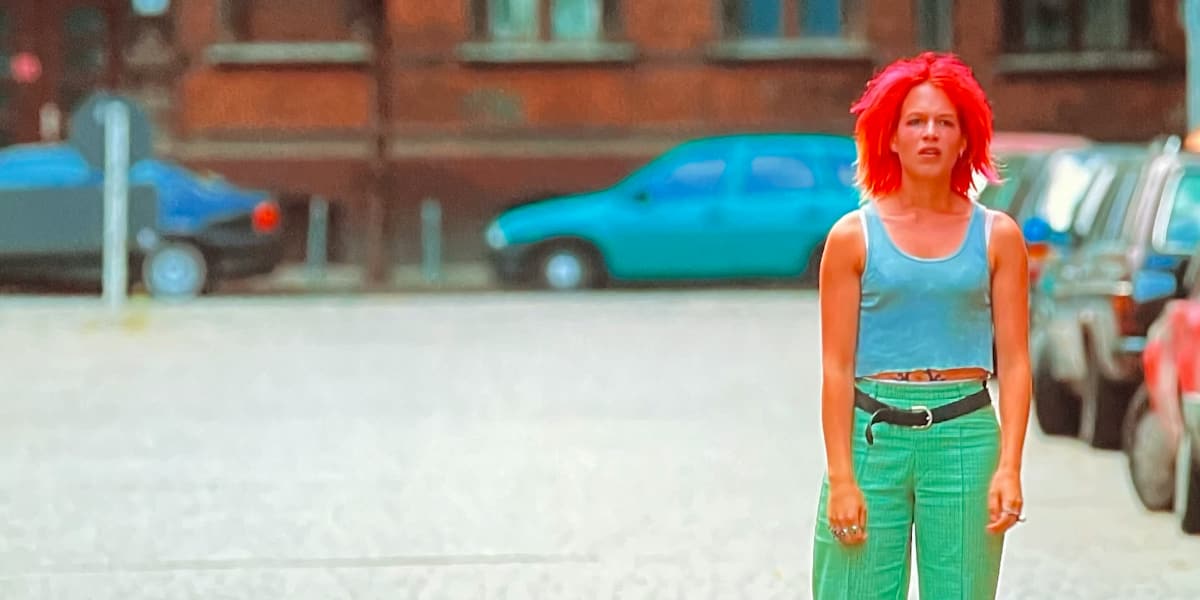
Run Lola Run
Lola and Manni are at a relationship crossroads. Manni is trying to make a living doing jobs for a Berlin gangster, Ronnie, and as a test of competence is told to pick up 100,000 DM of diamonds, sell them and bring the money to a rendezvous at midday. He accidentally leaves the bag of cash on a subway train and phones Lola in desperation. She tells him she will fix things, and she’ll meet him with the money he needs—but she only has twenty minutes to somehow make things good.
I saw this in the cinema when it came out and I remember being blown away by the mixture of pulsing techno, Franka Potente running through the streets of Berlin, and the looping narrative. I hadn’t seen anything like it before. I’d forgotten the animation, the philosophical game the film is playing, and the ways character arcs spin in different directions each time Lola’s actions deviate in very small ways.
It’s a beautifully edited film, and it plays with the ideas of free will, destiny, chance, desire and love. Lola’s agency creates the second loop through the timeline, and it’s ambiguous if Lola or Manni create the third, but each time through Lola seems to remember small details from the time before, and her screams at moments of extreme stress certainly bend reality to her will.
The central question of whether the couple can be together is answered when Manni steps up to solve the problem he’s created for himself. There’s an implication from the beginning that he tends to rely on Lola fixing things for him. By the end the lovers are equal.
July 25 2025, 13:49
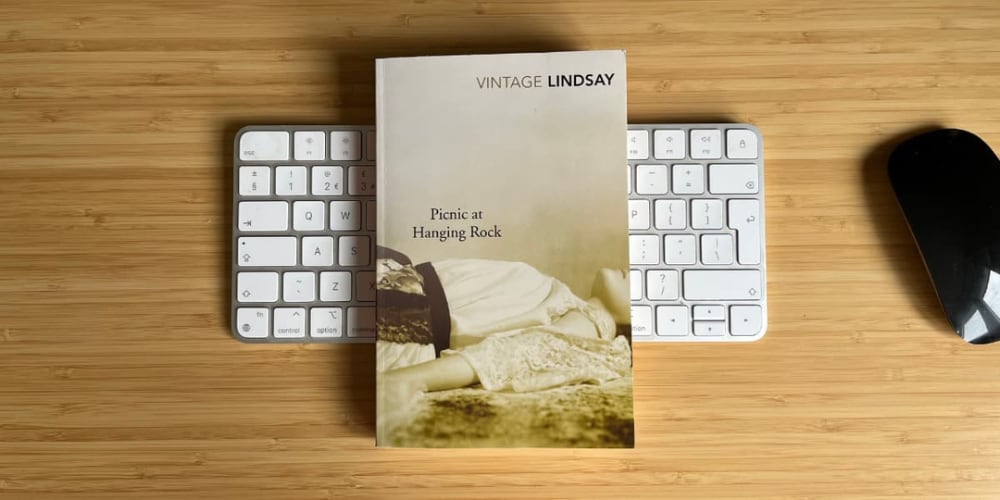
Picnic at Hanging Rock (novel)
~110,000 words. Third person, many characters.
My daughter bought this for me for my birthday in March, and I wanted to watch the Peter Weir film for #ArthouseSummer2025, so it seemed right to read it before the film images infected my imagination.
Three schoolgirls and a teacher go missing while on a picnic at Hanging Rock, a volcanic rock formation in Victoria, South Australia. The police and locals search the area but can’t find them. A week later, two men return to the site and miraculously find one of the schoolgirls still alive. She has no memory of the incident, and the mystery of the other missing girls lingers and affects people in unexpected ways.
The story unfolds through the eyes of the many characters linked to the boarding school and local community. In the opening chapters, I was overwhelmed by the number and variety of perspectives. It’s impossible to remember who is who at first. The authorial voice is front and centre, and it’s told as if it is a true story, including letters and newspaper reports. There isn’t a single protagonist; instead we observe people going about their lives at all levels of Australian society, from the schoolgirls, to gardeners and cooks, teachers, police, holidaying gentry, settlers, and the Appleyard School’s malevolent owner and headmistress, Mrs Appleyard. The effect is a chorus of voices worrying over their lives with the central mystery of the disappearances always in the background.
The details of the natural world and structures (physical and social) humans create in it are exquisitely captured. There is a consistent sense that nature hums behind everything the characters do, in insects, vegetation, weather—sometimes they notice it, but usually they don’t because they are caught up in the social and economic necessities of their lives. The Hanging Rock inspires both awe and fear. Humans are a small part of nature’s ecosystem, and the rocks are a reminder of individuals ultimate insignificance, as well as the threat of chaos cutting through attempts to feel in control in the unpredictable wilderness.
The novel seems to be saying that some things are unknowable. On a process note, Lindsay wrote a final chapter that her editor advised they cut out, and that decision gives the book its defining mystery. While poking around on Wikipedia, I read the summary of the original ending, and while it makes sense of the whole book, it also detracts from it, because pondering the mystery of the events is why to me the book is powerful. Part of me wishes I hadn’t found out the author’s intention, or at least not so quickly after reading the last sentence. It's a curse of the modern age to have facts so readily to hand. It’s probably better to engage with a piece of art on its own terms, at least for a while, to get a fuller experience of it, before trying to find out more.
July 23 2025, 14:23
The Fog
~110,000 words. Third person, many characters.
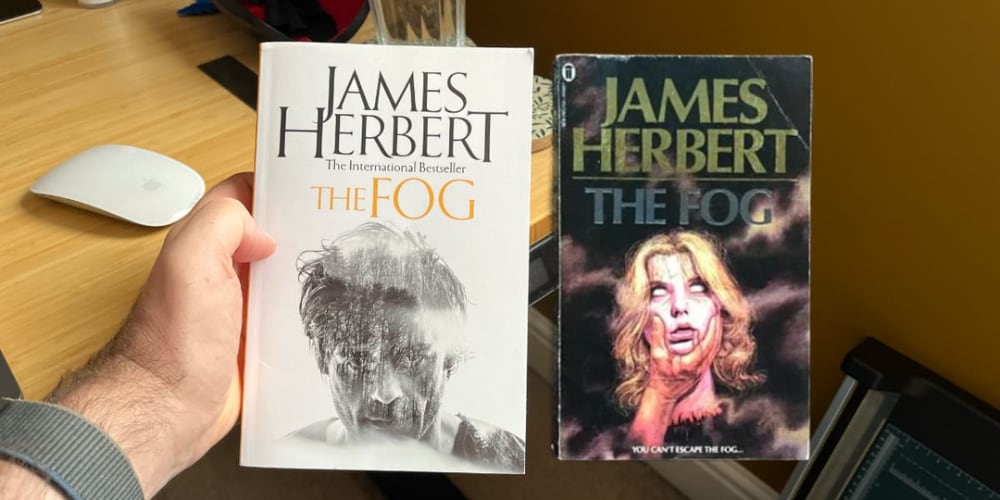
This is one of those formative books for me. I mean, look at the cover! The one I have now is on the left, but the hastily Photoshopped one on the right is the edition I owned in my teens. My father was bringing horror books into the house all the time growing up, and I think I discovered Herbert’s Lair first, which was the follow-up to his first novel, The Rats. I remember a classmate reading The Rats in school and showing everyone the gory bits. For emotionally-stunted twelve-year-olds, these were catnip as representations of the repressed horrors of adolescence.
The Fog mostly follows John Holman, an environmental inspector who specialises in covert investigations of Department of Defence land. An earthquake opens a crack through a rural English village, demolishing it and releasing a yellow-tinged fog into the atmosphere. Holman’s car falls into the hole and he is one of the first to be exposed to the fog, which sends anyone in contact with it insane (usually into a sadistic rage). He is the only person to recover, and he is asked by the government to help as the fog is blown around England leaving mayhem in its path.
I didn’t remember much about this beyond one standout scene that was tattooed into my brain involving a private school, a possibly paedophilic teacher and some pruning shears. Holman is the protagonist, but the point of view jumps between many characters as they are affected by the fog. It’s astonishing the range and depravity of the things Herbert imagines people doing to each other, and each character gets a back story, perhaps an injustice, and then a horrible revenge and death. It’s a collection of short stories in that way.
It drags in the second half, more like an uber-violent sixties Doctor Who, with the army personnel, provincial English life, government officials from the MoD, and a bordering-on-alien enemy. By the time the fog reaches London, the extended route Holman is forced to take to find the fog’s heart allows Herbert to describe a Hieronymus Bosch–style hellscape of brutality and despair. It’s written well enough, but there’s no character development or subtext—the seventies equivalent of Victorian penny dreadfuls.
It was fun to revisit. I wouldn’t want another any time soon.
July 16 2025, 18:56
Splashing in the shallows
A month ago, I said I was going to try new things, and that’s what I’ve done. I started swimming lessons. I had a guitar lesson (with another tomorrow). I redesigned this website and built it under a new domain name. I read a non-fiction book about the prolonged death of neoliberalism.
As a reward for taking these small risks, I had some dreams, one of which involved an obscure conversation with my father in a deserted castle. It’s a potent time. It’s a good start.
I’m getting close to my summer break, which is exciting. In August, I’m off for three full weeks. It’s not like any other summer I can remember, because my wife and daughter are going to Vietnam, and I’ve chosen to stay home. After Australia in November sucked up most of my annual leave, I couldn’t face another adventure holiday. I haven’t had a week off since my Arvon week in February, and that wasn’t a rest. Instead, I’m going to relax at home. Alone.
The alone bit is unsettling. I don’t think I’ve been alone for more than a weekend in thirty years. There was always a child, or both children, when my wife was away, and before we met I was in a succession of house shares. Someone was always about. I'm always making a meal for another person.
I’ve started a list of things to do. I know this is a defence against the possibility of feeling lonely. It would be more radical to let the holiday come and not have plans. The only thing I truly don’t want to do with the time is fill it with online bullshit—the news, YouTube, Bluesky. I want to be bored, I want to relax, and I want to follow my nose.
Having said that, I really fancy getting the train to London for a couple of days and going to an art museum, some book shops, a good restaurant. And I want to go swimming in the daytime. And I want to get into a film project to post about on the website. And I want to keep writing the novel.
Only a couple more weeks. It’s close.
June 17 2025, 21:49
Satin Island
Jonathan Cape. ~45,000 words. First person, as U.
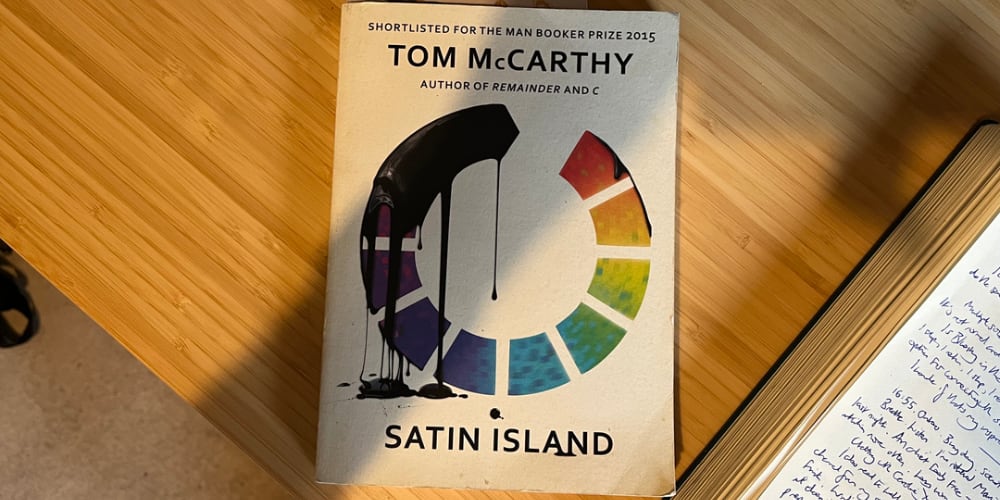
I bought this in Barter Books, Alnick, because of the beautiful cover, unusual size, and the blurb proclaiming it was shortlisted for the Booker in 2015. The cover has a colour wheel of some kind with a coating of oil on one side. The drops of oil on the opening pages become a more insidious seeping coat of it by the closing pages. Oil keeps coming into U’s head after he sees an oil tanker leakage on the news while stuck at an airport in Turin.
The opening sentence describes the Turin Shroud, an artefact that represents peoples needs for foundation myths, and is also provably false. As an anthropologist, U’s job is to find meaning in the patterns of the world. He works for a corporate consultancy where the conman-genius CEO Peyman hobnobs with governments and global brands. Peyman believes the company doesn’t sell knowledge, but fiction, invented narratives, and in that spirit instructs U to write the Great Report on their company. Unwilling to admit he has no idea what that means, U loses himself in unlikely research. The death of parachutists around the world. The effects of the oil spill. The history of his field, anthropology, and his hero, Levi-Strauss.
There are other characters U spends time with. His friend Petr who discovers he has cancer. Madison, a girlfriend who sends him lusty messages when he’s away, but keeps him at arms length when he visits. A work colleague, Daniel, who spends his time studying the traffic patterns in a Nigerian city, and the legs of hundreds of roller skaters as they skate past a camera. U is desperate for recognition at his workplace and is able to spin outrageous ideas out of seemingly random data, but in Petr he faces death, and in Madison someone to possibly love.
There’s an extended sequence towards the end where Madison tells a disturbing story about why she had once been at Turin airport that brings the books themes to the fore—corporate greed, our need to belong, our susceptibility to power and powerlessness, and how we spin tales to make it feel like what we’re doing is normal. Consultancy is a business built on selling fiction. U is a professional bullshitter. By the end, all becomes clear.
June 15 2025, 13:34
Soft machine
I’m thinking about digital gardens and my creative mechanisms. Making anything involves ideas, craft and tools. My current mechanism feels like a meat grinder. I’ve managed to make “creative writing” into something brutal and excruciating. Time to dismantle the machine.
This is what I do now
I go to the gym for weights. I stretch my hips at home.
I write in my notebook (a lot) to help me process things going on in my life, some dreams if I’m lucky, but mostly feelings and patterns. There are lots of notes towards a second novel.
I post to Bluesky, but recently I’ve been using an alt account because I needed to play around without censoring myself for an audience. I write the occasional blog post about my life. I read novels and post my notes on them to Patreon. Sometimes I’ll do a film challenge and post a series of short reviews. Once a month, I post a list of books read and films watched for paying patrons, and I started recording a vlog (which has stalled).
Every couple of years I redesign my website and move it to a new technology. I play a golf video game after work because it helps me relax and reminds me of my dad. My day job is mostly problem-solving, in software, systems and group dynamics.
My daughter introduces me to new music. I recently became obsessed with music reaction videos on YouTube—people recording themselves experiencing classic songs for the first time. (Coming off them now. I got addicted to the emotions.)
This is my creative life. Body. Bluesky. Blog posts. Novels and notes. Films. Coding (rare). Managing a team (9-5). A video game (one!). Music.
What’s the problem?
Anxiety. My anxiety says I’m not making anything. Not really. It says I’m not being serious. There’s no ambition. I say, I’m in survival mode. In other ways, I’m thriving, but my anxiety doesn’t buy that.
My mother was ambitious, my father wasn’t. Those two wolves still face off every day in my mind—one dissatisfied with her lot and wanting more, the other work-exhausted and wanting to hide in his burrow. I’ve created routines that serve the exhausted wolf because I’ve become a version of my father. My day job goes against my nature, but it keeps us all safe and warm. Dad climbed machinery in a steel works, I work at a desk with abstractions in code (and people).
Mum was a numbers gal, a bookkeeper, a jigsaw-lover, and did evening classes in all sorts of things. Dad read gigantic fantasy novels, watched old films and played golf. I have so many more opportunities than either of them had. Work makes the weeks go fast. Children make the weeks go faster. My notebooks fill up with the same old spirals. I keep thinking of my age, the age Mum was when she died, when I’ll die.
Possibilities
I want a softer machine, perhaps even something organic. An animal. A wolf wearing reading glasses. A panda. A Cronenberg-style metal-flesh hybrid. A naked woman. Talking books on a walking set of bookshelves. All of these. I want making to be fun.
It’s important I’m not just writing. The Bluesky alt account showed me the wonders of a free(r) libido. The animal wants what it wants and is surprisingly easy to negotiate with if I’m respectful. There’s no reason to limit myself. Piano. German. Learning to draw. Dungeons & Dragons (I loved being a Dungeon Master as a teen). Photography. Tennis. Travel. Let’s go!
Wanting success is the problem. The illusion of hard work guaranteeing success is baked into our culture. My mother believed it. Dad didn’t. The pressure that comes with that crushed the joy out of writing for me. I’d rather be ambitious for a full and interesting life.
What’s next?
I realise I’m restating similar ideas to my last post. That’s how it works in this house. I’m going to replace my author website with something more playful. I might link to a YouTube channel. I’m going to write less in my physical notebook and work through my daily shizz in more creative ways. Sometimes this will be online, mostly it won’t. There will be new skills.
I’m excited to be a beginner again. It’s going to be uncomfortable. My censor will try to block me. The internal chorus will try to shame me. The overwhelming feeling I have is a deep regret I didn’t understand all this sooner mixed with excitement that there is a wave building through these words with so much energy it could take me somewhere completely new.
June 07 2025, 11:58
Gabriel’s Moon
Penguin. ~100,000 words. Third person limited, as Gabriel.
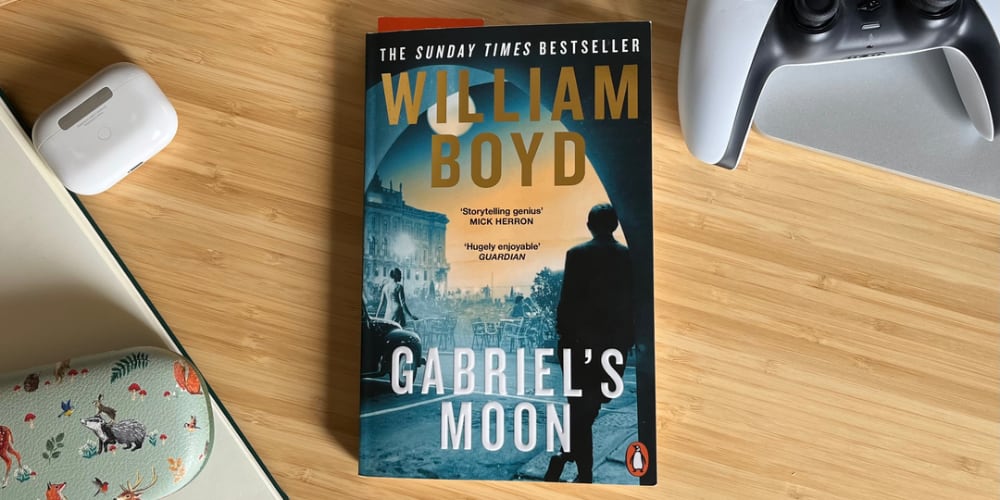
I was looking for something literary and genre, and I remember loving Any Human Heart many years ago. I know Boyd has written several spy novels, but I didn’t finish the last of his I tried (a whodunnit about Freud and Vienna), Waiting for Sunrise. I find whether I enjoy a book hinges on the time in my life, what I’m looking for, my mood, all sorts of things. That doesn’t sound very academic, but then... I’m not an academic.
It opens with a young Gabriel Dax escaping a house fire. His mother dies and he is brought up by an art dealer uncle, away from his much older brother, Sefton. In his late twenties, making a modest living as a non-fiction writer and journalist-for-hire, he tapes an interview with a dictator in the Congo who is convinced he is to be assassinated. Returning to London, Gabriel hears on the news that the man was indeed killed, and the tapes he made have become hot property. He is slowly pulled into the world of MI6 by an enigmatic handler, Faith Green, who begins to pay him to do small errands across Europe. At the same time, he is seeing an analyst for his insomnia and nightmares who encourages him to find out more about his mother’s death.
After the more experimental approaches of recent books I’ve been reading, this was a traditional, straight-down-the-middle spy novel given sparkle by Gabriel’s vivid characterisation and parallel investigation into whether his night light really did burn down his family home. Boyd gets us into the head of someone being gradually seduced away from a relatively dull life into a more exotic and dangerous world. There are transcripts from his taped sessions with his analyst, Dr Katerina Haas, and excursions to meet loss adjusters and firemen in rural Oxfordshire, alongside days spent on unexplained assignments in Spain and Poland.
I liked the balance between plot (keeping the mysteries alive) and character (so I cared what happened to Gabriel). It’s the longest book I’ve read in a while, but it didn’t feel it because the prose is silky smooth in the main. My editor brain can’t help but find some bits a bit clunky, but that’s just my taste showing. This is how William Boyd does it. I’m not complaining. There’s lots to learn in here.
June 01 2025, 14:32
Reconfiguration
I’m switching the domain name of this website to michaelwalters.uk over the coming months. I bought it on a whim, but I knew something was brewing, and I was right. I don’t want to lead with my writing persona in public. It’s become a burden. I’m still going to write, but removing the author label frees me up mentally to do other things.
I came across a letter in an old notebook last week. I wrote it in October 2009. It was one of those self-help exercises where you imagine being on your deathbed giving advice to your younger self. It was cheesy in places, but mostly sweet and insightful, for example:
“I was really proud of the quality time I spent with my children. It set them up for joyful, fun lives.”
“Most of the good you will do in your life will be done in relationships.”
“I had most fun making things and working out how things can be made better.”
“There is no such thing as a perfect life, only an engaged one.”
Isn’t that wonderful? What a gift! That’s how I got to be where I am today. I was never interested in climbing the career ladder or making lots of money. I wanted to be sociable, family-orientated and to make things. That’s still true. I’ve been feeling depressed lately at lack of progress in my writing and software careers, but it’s good to remember that I have always chosen my path.
Now the kids have grown up, I can change things up. My mother loved to learn new skills, usually in evening classes at the local college: calligraphy, sign language, glass engraving, embroidery, all sorts of things, and I want more of that energy in my life. She had barely retired when she died at sixty-seven. I’m fifty-two. I want to make smart decisions.
I've been having dreams where I’m walking around big old houses that are run down, leaking water or crumbling in some way. We’ve bought them, and they need a lot of work. Mischievous characters help and hinder. The buildings are expansive, often historical, and full of possibilities. In the one I had last night, I wanted to turn one half a house into a school for the arts. Mum would have approved.
Words are not enough. I want to find new ways to express myself. I want to finish more projects. Creative living includes physical health and relationships. I want to feel playful instead of pressured. In these dream spaces, there’s plenty of room for others. I want to see who else I can be. I want to meet new people.
I feel fired up. This is going to take a while to establish. I’m not in a rush. I want to do more of what was in that letter I wrote to myself in 2009. Friends. Interesting projects. Fun!
May 21 2025, 19:35
Good Morning, Midnight
Penguin Modern Classics. 155 pages, 300 words/page, ~46000 words. First person as Sophia.
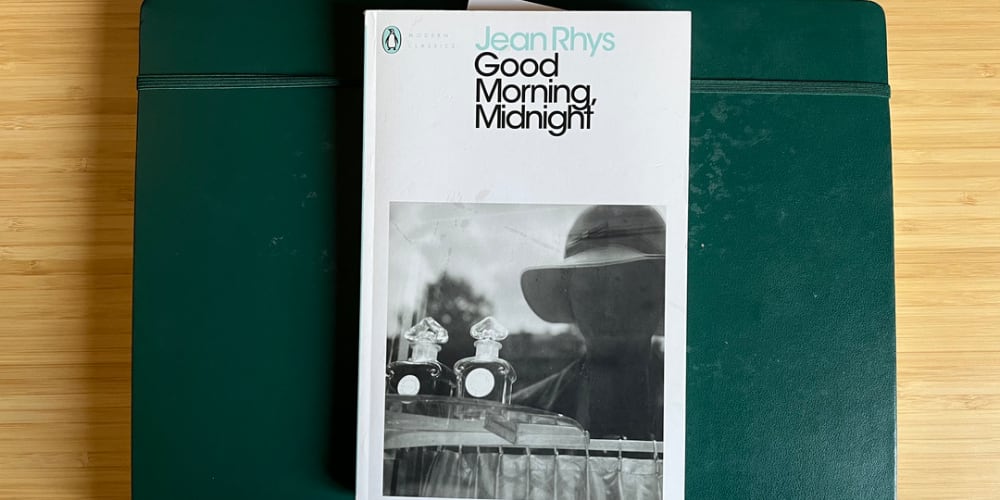
Reading the afterword by A.L. Kennedy, this is the fourth novel in a row where Rhys was working with a similar character, as if trying to find the ideal version of her: intelligent, lonely, processing personal tragedy, and struggling with alcohol. I read this in 2018, and I remember being impressed by it, but I didn’t remember the misery and desperation that runs through every sentence.
In Paris, on a holiday from her life in England, Sophia can’t take a step without being overcome with memories of previous visits. Her days are empty except for meals in local restaurants and drinks in bars. She establishes a routine and tries to occupy her time, but finds herself remembering her husband, Ennio, and being pregnant, the various jobs in clothes shops, and the endless hotel rooms she’s moved through, all the same. She’s trying to find a way of living that’s satisfying, no more than that, independent of her family and friends in London, and relying on no-one.
She meets a series of men, none of them very pleasant, and her state of mind deteriorates, but the details Rhys plucks from her experiences are interesting, surreal, often funny, and always with a dark twist. The way Sophia shifts from the present into memories, dreams, fantasies and back again makes Sophia feel real and relatable. It’s something I can use in my work-in-progress.
It’s terribly exposing to show despair as deep as this in first person. I’m not brave enough to commit to first person as my own character’s point of view in Peninsula. Third person feels like a safe pair of running shoes in comparison. First person is terrifying. It might also be the most revealing while I’m still exploring the story. Perhaps that’s a challenge I should take up.
May 14 2025, 09:00
Ghost Wall
Granta Publications. 145 pages, 250 words/page, ~36000 words. First person as Sylvie.
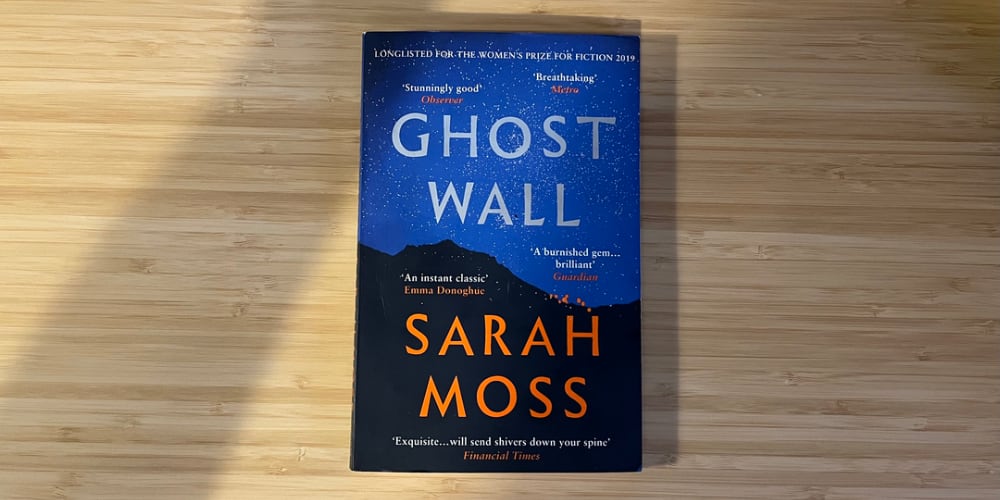
This was a tough read. The prose is lyrical, often beautiful, but the physical abuse Sylvie suffers was hard to stomach . It opens with the sacrifice of a young woman at some time in the past by the community she grew up in. Then we meet Sylvie who, with her parents, is on a field trip with a group of archaeology students in modern-day Northumberland.
Sylvie’s father is a bus driver with an obsession with the Iron Age, and he’s managed to tag along with a professor’s class who are to live as people would have done over a thousand years ago. They wear scratchy tunics, use similar utensils, hunt and forage in the local woodland, and wash in the nearby river. Sylvie wants to be more like the carefree students, but her father is strict and abusive, even in front of the others. Sylvie is attracted to Molly, one of the students, who notices marks on Sylvie’s back from her father’s beatings and decides to take action.
The story swings between the overbearing world of Sylvie’s parents and the freedoms of the students. Her father has a racist idea of being connected to the original peoples of Britain and believes women should be controlled at home. The professor ignores these attitudes and indulges him in long conversations about how things might really have been. The students know something is wrong, but only Molly steps up to help Sylvie break free. It’s a story about the complex feelings of being a victim of abuse, the suffocating patriarchal structures that exist now and all through history, and how in a group people often don’t challenge authority even when something is going obviously wrong.